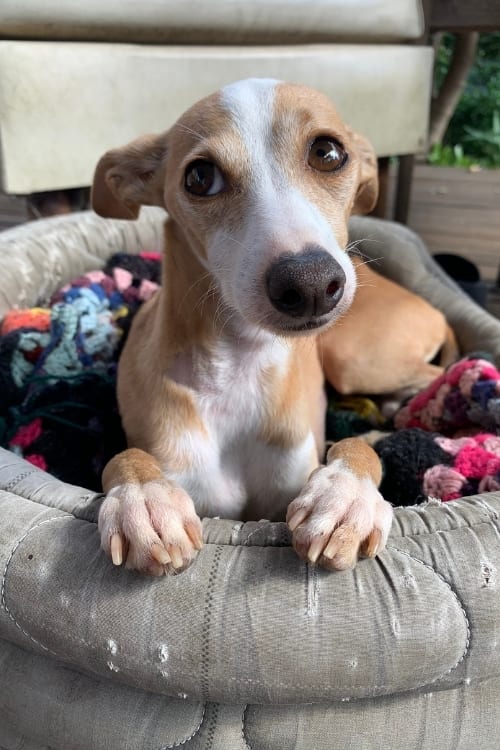
Lenny is a two-and-a-half-year-old Italian greyhound. He came to Lort Smith because he was having trouble urinating, and couldn't run around at the dog park.
Over many months, Lenny had countless blood tests, X-rays, ultrasounds and an abdominal CT scan. At first, Lenny was diagnosed with a blocked urethra caused by bladder stones, and he needed surgery. The surgery was successful. Our vets removed the stone from his urethra without any complications, and washed more than 30 stones out of his bladder.
We investigated further, as it's unusual for a young, seemingly healthy dog to have bladder stones. Tests showed Lenny had an extrahepatic portosystemic shunt (PSS). This is an abnormal vein connecting the blood supply returning from the intestines to the vein returning blood to the heart, bypassing the liver.
We really do believe that so many people being on Team Lenny helped him to come back to us!
Susie, Lenny's carer
A difficult decision
Lenny's devoted carers had many conversations with our vets about PSS and the surgical and medical options.
Dr Jonathon talked to a specialist surgeon about referring Lenny for surgery, as his presentation wasn't typical. The surgery was expected to cost more than $6,000.
"This was heartbreaking because we felt we were going to have to let Lenny go. Not long after this I received another call from Dr Jonathon who, after discussing with the specialist, was happy to perform the surgery at Lort Smith. Dr Jonathon had completed this type of surgery several times. It was quite the emotional rollercoaster that day!" remembers Lenny's carer, Susie.
After weighing up the pros and cons, the decision was made to go ahead with surgery. The alternative was that Lenny would have ongoing problems with bladder stones and neurological problems, and might only have had a few months to live.
Fighting back
Lenny had surgery in mid-April 2020, during the COVID-19 lockdown. He spent a couple of days in hospital and seemed to recover well. But once home, he deteriorated. He was weak, not eating and losing weight. He went into our ICU, and his sweet little life hung in the balance.
Lenny had developed a severe infection at his incision site and in his abdomen (peritonitis), which caused some of his abdominal muscles and skin to die. He needed extensive surgery to remove the dying tissue and get on top of the infection, which was likely the result of his poor metabolic state due to his condition.
From an ultrasound, we also suspected he had developed portal hypertension. This can happen when a band is placed on the vessel too tightly, or if the band causes the shunting vessel to kink. Dr Jonathon loosened the shunt clamp while dealing with Lenny's infection.
Tiny Lenny struggled to recover, despite antibiotics, fluids and excellent nursing and medical care. He was losing weight and ended up in a serious downward spiral, with very low blood protein levels. As a result, he developed oedema (fluid build-up) over his face and legs.
"A plasma transfusion seemed to help Lenny's protein levels and his oedema improved. Unfortunately, Lenny then became anaemic. His little body seemed like it wasn't going to be able to heal when Dr Jonathon called and asked if we would consent to a blood transfusion. I later found out that Dr Jonathon had gone into work on his day off to bleed his own dog for Lenny's life-saving blood transfusion," says a very grateful Susie.
The blood transfusion was the turning point for Lenny, even though he still had a major wound that needed frequent dressings, medication and tube feeding to get his weight back up.
Back to his kooky self
"We were working from home so able to be full-time nurses for Lenny, with feeds every few hours and major wound dressings, and lots of love and care. Lenny's wound took months to completely heal and his weight has taken a long time to reach an acceptable level," says Susie.
Lenny's recovery at home was helped a lot by his adoring fur-sister, Miss Beats, a black cocker spaniel.
"Beats loves Lenny like a sister/mother. When he came home from his surgeries, she sat next to his bed just keeping a vigil. She was very reserved when Lenny was in hospital, she wasn't interested in games and was often hard to be close to."
"Lenny is great now and back to his usual kooky self. He is happy, playful, energetic and more loving than he ever was. He likes to run around the bush and on the beach. Lenny loves to lay in front of the fire until he is nearly cooked and he enjoys being wrapped in a blanket on one of our laps."
"Nearly losing Lenny affected our little family so much, as well as our extended family and friends. It felt like he touched so many hearts. Not only did we have the amazing love and care from Lort Smith we were surrounded by love and care from our community. We really do believe that so many people being on Team Lenny helped him to come back to us! We are eternally grateful to everyone who cared so beautifully for him and for us."
"Special mention to all of the staff at Lort Smith that were providing this care during COVID-19. On a number of visits to Lort Smith we were met by staff running out to our car in the pouring rain to get him and take him inside. They were consistently friendly and loving toward him even under such challenging circumstances," says Susie.
Lort Smith continues to monitor the regeneration of Lenny's liver.
You can follow Lenny on Instagram: @miss_beats_and_lenny