
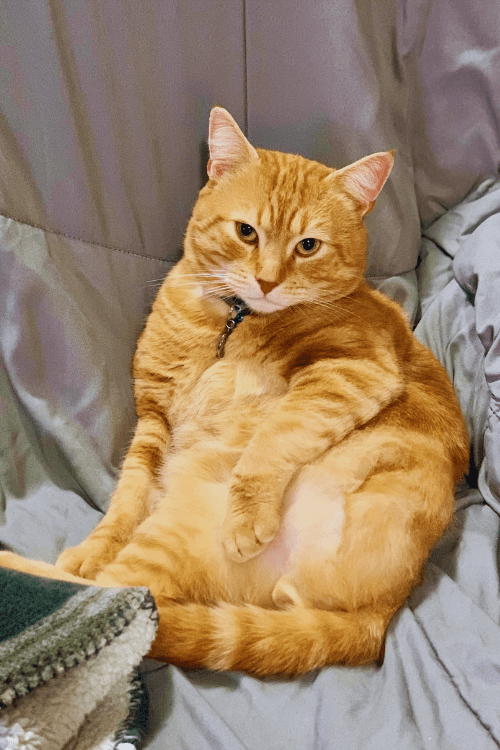
Lucky, a five-year-old ginger cat, came to Lort Smith after it was suspected he had been hit by a car. His carers told us he had been missing for days, and when he came home, they knew something wasn't right. They brought Lucky in to see Dr Brittany, who agreed that Lucky hadn't been so lucky and needed urgent medical treatment.
Dr Brittany assessed Lucky and found his left back leg was broken. Lucky was limping and couldn't put weight on it. X-rays confirmed he had a fracture that would need either a bone fusion or an amputation. After much discussion and consultation, the team decided amputation was the best option for him. He also needed all the teeth on one side of his face removed, because of the suspected car accident.
Lucky was surrendered into our care and recovered well from his surgery. Like most animals who have an amputation, he was happily strutting around on three legs within a couple of weeks. He settled into his foster home with one of our Animal Welfare Officers, Beck, who cared for him as he recovered.
Lucky for Lucky, he still has eight lives remaining …
Pillow foot
Beck soon noticed that Lucky's paws were changing. They looked inflamed and swollen, and he couldn't walk for long, taking just a few steps before lying down again. Beck brought Lucky in to see a vet, who diagnosed him with plasma cell pododermatitis, commonly known as "pillow foot". Pillow foot is caused by the immune system being mistakenly triggered, often by a minor infection the body tries to fight off. In doing so, it overproduces white blood cells, which pool in the foot pads, causing pain and inflammation.
Fifty per cent of cats who develop pillow foot are affected by feline immunodeficiency virus (FIV). That was the case for Lucky, who had tested positive before his first surgery. FIV interferes with the immune system and depletes white blood cells, making it harder for cats to fight off illness and disease.
After a few weeks of steroid and antibiotic treatment, Lucky's pillow foot had almost entirely disappeared. Beck's diligence and care meant his condition could be treated early, which is vitally important for cats with FIV. Lucky's pillow foot may return in future, and he may be more likely to get diseases or infections than other cats, but many cats with FIV live a long and otherwise healthy life.
Staying put
Beck first fostered Lucky so he could have some time away from the hospital and recover at home, but she quickly fell in love with his gentle personality and fondness for belly rubs. Beck's family felt the same, and together they decided Lucky would stay for good.
Lucky for Lucky, he still has eight lives remaining …